| |
Aikido Westchester NY: Aikido Westchester Lineage
|
Aikido Southern Westchester County, LLC
A Video Essay of our Lineage...
with written description below:
|
|
|

Morihei Ueshiba (1883-1969)
|
Aikido founder, Morihei Ueshiba (1883-1969), was known as one of the more advanced martial
artists in the history of the world. His approach and methods transcended the limitations of
physical conflict to embody universal compassion as the source of effective technique. His system
resulted in effective self defense, a means to improve one's health and a discipline for a better
sense of peace. As a traditional martial artist, he engaged in conflict with some of the well known
martial artists of his day in a more realistic setting than the competition currently used to
approximate real life circumstances. He remained undefeated, demonstrating his commitment to
humanitarian values as the genuine source of effectiveness in self defense technique. Morihei
Ueshiba effectively transmitted his are to a large number of advanced instructors and as a result
his lineage is very much alive today.
|
Morihiro Saito (1928-2002) 9th dan
|
Morihiro Saito was one of the top students of Morihei Ueshiba. When the founder of Aikido
retired from the Tokyo community for the remaining 23 years of his life, he moved to a small town
in Iwama Japan. While he still traveled to teach in Tokyo once a month, the bulk of his time was
spent farming and training in Iwama. Morihiro Saito practiced rigorously under the founder during
this time, while the bulk of Aikido instructors known today trained in Tokyo primarily with the
founder's son and some of his well known students there. The founder of Aikido developed the
weapons system in Iwama, leaving Morihiro Saito as the only heir to both empty handed technique as
well as weapons. While the training in Tokyo was fluid, training in Iwama tended towards being
direct and effective in the early years. A heavy emphasis is placed on basics and breathing as well
as weapons, distinguishing the style from the Tokyo system, whereas fluid technique evolves with
more advanced training. Morihiro Saito lived in Iwama Japan throughout his life and trained
students worldwide through their periodic intensive visits to Iwama as well as continued
instructional tours.
|
|

Seiichi Sugano (1939-2010) 8th dan
|
Seiichi Sugano was a direct student of the founder of Aikido through the Tokyo system, focusing
his technique on the study of timing. He was dispatched to Australia first, followed by Belgium and
eventually New York City in 1989. Seiichi Sugano was one of the most advanced practitioners sent to
the United States. As he studied with the founder of Aikido only once a month, he developed his own
weapons system which evolved out of his additional study of western style sword fencing. Both his
empty handed technique and weapons training focused intensively on the perfection of timing as a
vehicle through which one could come to understand all aspects of Aikido. Other instructors may
emphasize different aspects such as connection, generating power from a static position, etc. The
Iwama system can include all aspects in its approach.
|
|

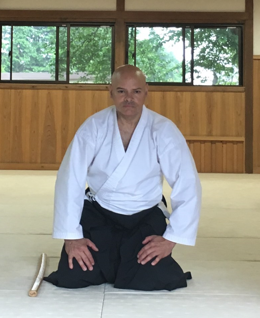
Hoa Newens 6th dan
|
Hoa Newens Sensei studied directly and extensively with Morihiro Saito Sensei. He is a member of
the board of directions of the Takemusu Aikido Association. Many other advanced instructors
populate the Takemusu Aikido Association. Some examples include Wolfgang Baumgartner (6th dan), Kim
Peuser (6th dan), Hans Goto (7th dan), etc. Hoa Newens Sensei has taken direct responsibility for
the development of Aikido Westchester in a teacher-student relationship. He began Aikido in 1967
and student with Dang Thong Phong (Vietnam) as well as Seiichi Sugano in his earlier years. As
such, he is knowledgeable on how to incorporate the instructional methods of Seiichi Sugano into
the more comprehensive system developed by Morihiro Saito Sensei.
|
| |
In addition to direct instruction from the teachers above, the Aikido Westchester dojo attempts
to participate in informal instruction when possible with a number of teachers, some examples of
which are the following:
|

Hitohiro Saito
6th Dan
|
Mitsugi Saotome
8th Dan
|

Hideki Shiohira
7th Dan
|
|
Steve Kanney (5th dan)
|
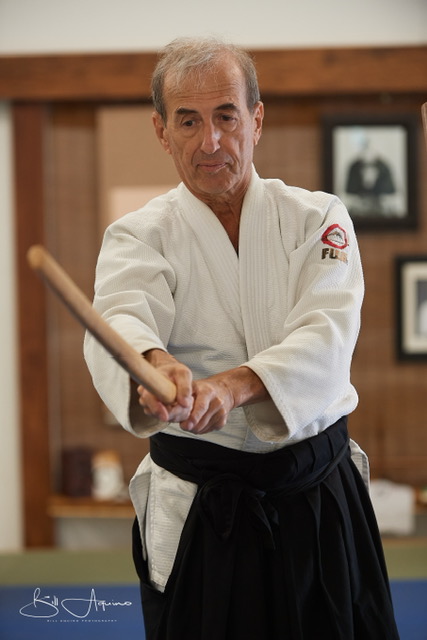
Steve Kanney is the chief instructor of the Aikido Westchester Dojo. He began martial arts
training in 1972, and Aikido in 1978. While starting with a student of Yamada Sensei, he first met
Morihiro Saito Sensei at a 10 day seminar in the United States in 1979. While he was not able to
move to Japan as a formal student of Saito Sensei, he did continue to follow his seminars in the U.
S. and practice on his own in addition to his regular Aikido training. He moved to New York in 1983
and first met Seiichi Sugano in 1989. His practice gravitated towards Sugano Sensei's approach over
time, while he continued to accumulate experience with Morihiro Saito Sensei. As Aikido is a
relatively new martial art, the community is now experiencing a transition from one generation of
teachers to the next. With the passing of Sensei's Saito (2002) and Sugano (2010), a search for the
next generation of instruction must be navigated currently. Steve acquainted himself with Hitohiro
Saito (6th dan), son of Morihiro Saito and one of the most advanced instructors of his lineage. He
also found many of the senior instructors of the Takemusu Aikido Association (of which Hoa Newens
Sensei is one) and Hideki Shiohira Sense, a more recent instructor from the Tokyo system.
As taught by Sugano Sensei, one can learn Aikido in two ways:
through the study of Aikido directly and through training in other forms of knowledge where one
learns take what they see and use it to understand Aikido. Steve Kanney has trained in wrestling (5
years), Karate (4 years), Jujitsu informally (4 years) and studied Tai Chi since 1999. He also
began the study of Chinese Zen with one of the more advanced teachers in the world from 1996 until
his teacher left the country due to health in 2006. Zen and martial arts training maintain a long
history of close association: “Zen discipline is simple, direct, self-reliant, self-denying…A good
fighter is generally an ascetic or stoic, which means he has an iron will. This, when needed, Zen
can supply.” - DT Suzuki Zen and Japanese Culture (pg 62)
|
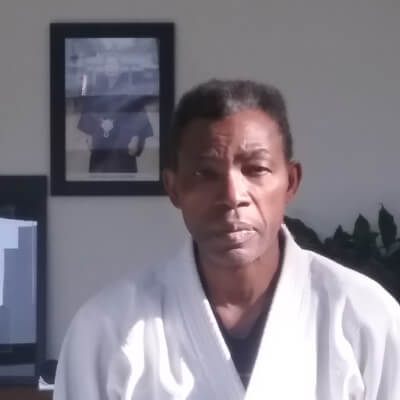
Nathalis Wamba
|
Nathalis G. Wamba started martial arts training at the age of six. He practiced Judo for over 15
years and switched to Aikido. He joined the New York Aikikai in 1982 where he trained under the
tutelage of Yoshimitsu Yamada Sensei and Seiichi Sugano Sensei. Over these years, he participated
in multiple Aikido seminars in the US and abroad, focusing on instruction from Sugano Sensei and
Tamura Sensei. His concentration on the training methods of Tamura and Sugano Sensei offers another
perspective. Additionally, his training with Tamura Sensei, the senior most practitioner of Aikido
in the western hemisphere, is particularly beneficial. Along with Aikido, he has practiced Kendo
and Kyudo.
In January 2010, he joined Scarsdale Aikido. Nathalis is a faculty member at Queens College and
lives with his wife and their two children in Hastings on Hudson, New York.
|
|
|