Interview with Sugano Sensei
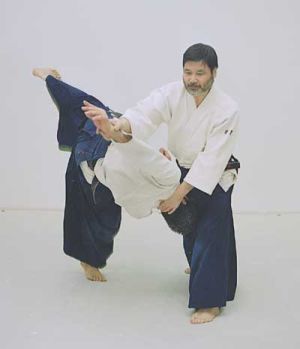
Brought Aikido NY, Belgium, Australia
[This interview has been reprinted courtesy of Aikido East, Fall/Winter 1998]
Sugano Sensei came to New York from Brussels, Belgium ten years ago and has been teaching at the New York Aikikai ever since. Like Yamada Sensei, Sugano Sensei spends much of his time on the road (or in the air), in Europe, Australia, and around the United States. The other day Aikido East sat down to ask a few questions.
Sensei, you have said that Aikido is made up circles, squares, and triangles. Could you explain?
These are symbolic shapes directly relating to the technical aspects of Aikido. Triangles generally represent the hanmi posture. A square is perfect because each corner has to be 90 degrees. Squares represent precision, you have to be accurate to make a square. In any technique you are aiming for accuracy and precision. The circle represents movement. These three elements encompass every Aikido technique.
Even ukemi?
Yes. Ukemi is part of Aikido.
Sensei, your style of Aikido creates a lot of energy. Is that deliberate?
Yes. The system of Aikido is based on interacting with others. If you're not interacting with another's energy, there is no system. The system exists to create energy. When I teach, I am responding to the students' responses.
Has your teaching changed much?
Well, my Aikido understanding is so different. On the other hand, some might say iriminage is iriminage, but the insides are very different. It's the same thing with students, they are continuously evolving. It's true that ikkyo is ikkyo, but the inner understanding is different. It's difficult to pinpoint. When I go back to Belgium, they see me as moving much faster. Perhaps consciously or unconsciously my way of using my body is changing and becoming more technically precise. More exact, more efficient.
Your classes are very strenuous. Do you plan that?
Aikido should create energy. If you only focus on what you see in the physical form, you tend to become static. I never have any plan to teach. Whatever comes out is the result of my experience, and knowledge. There is no intention to lead anyone in any direction. I want it to come spontaneously.
What are you looking for in your training?
In the traditional sense, training itself is a purpose. It is not goal-oriented, it's just everyday training. For me, probably, it's more internal than simply physical. I am looking for something, some way to communicate my experience through Aikido. O Sensei had Omotokyo as a language to describe his process. I studied Zazen intensively for three years but really I used it as a method to learn about meditation. I wouldn't want to mix Aikido and Zazen, I don't think it would be proper. I also studied acupuncture, but I didn't intend to actually treat people. Without certain intellectual knowledge, you cannot describe the matter.
Do you consider yourself a teacher?
Well, people follow me, so I guess I am a teacher, or an instructor.
If you weren't teaching Aikido, what do you think you would be doing?
I wanted to be a journalist. I was interested in being involved with current affairs. I liked the idea of moving around a lot.
Do you miss practicing yourself?
Not really. When I go to Japan, I always practice. It helps for purely physical conditioning.
Did you plan to become an Aikido teacher?
No, not at all. A few of us found ourselves in a unique position. We weren't really bound to become Aikido instructors but we just found ourselves in this position. It's not like people who train for years and then open their own dojos. We just happened to be in the right place at the right time.
Do you like your work?
I still find it fascinating. That's why I keep going.
Do you like your students?
I prefer not to use the term "students." I prefer to look at people as people, not as students. Looking at a person on the mat as my student has a feeling of possessiveness. I want to avoid that sort of feeling.
You have said that you consider Aikido more of a personal development than a martial art.
I prefer not to describe Aikido in the category of a martial art. When O Sensei created Aikido, he broke with the traditional concept of martial arts. That is how Aikido developed. Aikido is not for fighting but for harmony and love. If you look at martial arts from a Western standpoint, they are fighting arts. In Japan, Budo is vaguely known to involve mental and spiritual aspects. But here, people don't see it that way. O Sensei created Aikido to break through the traditional concept of martial arts. It was a simple thing, his idea, harmony with the universe. You train technically to be efficient and precise. Accuracy involves timing and rhythm. So if you understand that timing and rhythm creates a balance, then you begin to understand that's how we can stand on the earth perfectly. Earth has two forces balancing perfectly: rotation and gravity. If you understand that balance or rhythm, you can begin to understand that we're part of the universe. If you only look at Aikido like it's a martial art, for purposes of attack and defense, our training will be limited to those purposes.
Traditional martial arts were always passed on through a static method, kata form, passed on without changing. O Sensei broke that form. He moved spontaneously. Aikido, the way O Sensei developed it, is more like the best aspect of sports. Coaches teach repetition of technique and in that way, Aikido is like sports. People like to make a distinction between sports and martial arts, as if martial arts is superior to sports. I don't see it that way. I fence and I see it as very positive, a great way to foster personal development. In many ways, sports are much more open than martial arts. The technical accomplishments in sports are more exact. Many sports involve mental training as well, like Aikido. The results are good. Obviously, though, sports have competition and Aikido does not and that is a great difference between the two.
How come the spiritual aspect of Aikido is not talked about more?
The general training doesn't include that. You can come to it through the physical form. Then you can pursue it further if you're interested.
What advice would you have for people who study Aikido?
When people come to Aikido, they have to be clear about why they are coming to train.