Aikido Westchester, NY - Martial Arts, Self Defense and Fitness

                                                    - Saito Sensei Aikido Westchester
Scarsdale Aikido
4 Gray Rock Rd
Scarsdale, NY 10583
914-574-6498
For Email, see
Contact Us below
Excerpts from Takemusu Aikido Volume I by Morihiro Saito with Stanley Pranin
pages 1-5

It is difficult to appreciate the uniqueness of modern aikido without an understanding of its extraordinary founder, Morehei Ueshiba.  This
innovative man presents a challenge to historians not simply because he lived in an earlier age very different from their own he was
unusual even for his own time and cultural context.  His esoteric views are heavily influenced by the doctrines of the Omoto religion and are
barely comprehensible to modern Japanese.  The challenge faced by foreign aikido devotees who hope to absorb the founders of
philosophy is made even greater by the formidable barrier of the Japanese language.  The task would be seemingly hopeless were it not
for the aikido techniques themselves, which offer everyone an avenue of approach to the essence of the art, irrespective of language or
culture.  
                                                                                                                             
page 5

The martial art of aikido has in recent years achieved wide recognition both in Japan, its birthplace, and abroad.  This is a natural result of
the steady growth of the art over the past 40 years and, more recently, its portrayal in Hollywood films, seen by literally hundreds of millions
of people.  Although correctly identified as a martial art, aikido is apt to be lumped together in the publics consciousness with other well
known fighting arts such as judo, karate, kung fu, and tae kwon do.  

How does aikido differ from these other martial systems?  Apart from the clear-cut differences in technique, aikido is unique in that is solely
in art of self defense.  Aikido entirely lacks attacking movements, a phenomenon which reflects its philosophical and ethical principles.  
Other martial systems possess both offensive and defensive techniques, and many of them have come to stress the sporting aspect.  This
is the case, for example, with judo, an Olympic sport since 1964, karate, and tae kwon do, as well as various other arts.  For many
practitioners of these martial forms, participation and victory in competitions are more important than learning techniques for self defense.  
The emphasis in aikido is on the spiritual growth of the individual for the acquisition of defensive skills.  The ethical dimension of aikido
permeates every aspect of its practice both on and off the training that.  And the philosophy of Aikido's founder, Morehei Ueshiba, aikido is
a means for uniting people into a "one world family." It is not a means for hurting others, but is rather a way of "loving self protection.  
Ideally, when confronted with the situation of physical conflict, the skilled aikido practitioner applies only the amount of control accessory to
neutralize the attack, at the same time seeking to avoid injury to the attacker.  In fact, serious devotees of aikido aspire to an even higher
level.  They attempt to live life in such a way that they are sensitive to conflict and potential violence in all circumstances, be it on an
interpersonal, societal, or any other level.  Situations of physical confrontation are to be anticipated and avoided altogether through the
cultivation of self confidence, heightened awareness, and foresight.  The realization of this goal inevitably requires many years of diligent
practice.  But aikido is a lifelong discipline, and sincere practice brings with it ever improving technical skills and a deeper understanding of
human nature.  

Since its goals are distinct from other combative of arts, aikido tends to attract persons interested in its principles of harmonious interaction
and conflict with resolution.  Those who are primarily interested in acquiring fighting skills for street defense or for purposes of competition
quite naturally gravitate to other martial arts.  But it would be incorrect to assume that aikido practice is not vigorous or that its techniques
are ineffective.  Practice in the traditional matter as taught by its founder, Morehei Ueshiba, aikido retains a strong martial edge.  
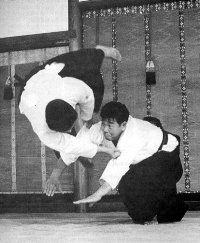
Techniques are executed firmly, but without violent intent.  Powerful joint-locks and pending movements control and immobilize the
adversary without causing crippling injury.  Aikido techniques are indeed capable of causing serious bodily damage or even death.  
However, the principles of aikido proscribe such destructive behavior.  
                                                                                                                             
pages 1-3